Every year, in the last week of July, many moons ago and many miles away, games were held in memory of the god Lugh’s mother, who died clearing the plains of Ireland so the people could eat. He asked for them to be held every summer after, so no house would ever go hungry again.
The games were a huge affair, with people coming from miles around to take part in wrestling, the throwing of stones, and all kinds of other games and events, finishing with the grand race, a winner-takes-all-and-more event that only the strongest entered.
This particular year, there was a girl called Eithne, who wanted no part of any of it.
Eithne was the baker’s daughter, which at Lughnasadh made her briefly one of the most important people in the village, but most of the time she was fed up with the way things were.
She had worked in her father’s bakery ever since she could walk and could tell you exactly when a loaf was ready just by looking at it, could knead and mix at the same time, and never forgot the salt.
Her father’s ovens had fed the village for two generations, but times were getting tougher, because the mill owner had decided that his son, Bres, should marry Eithne, and every time his advances were shunned he raised the price of the flour or refused to deliver it.
It had not escaped the village’s attention, but the miller’s family were as mean as they were rich, and no one messed with them, so it was mostly ignored apart from a few grumbles about the price of bread these days.
There was a young lad called Conor in the village, and he saw what was going on. He wasn’t the biggest lad at the games, or the fastest, or the one anyone would have pointed at and called a champion, but he had a way of watching a situation until he understood what was actually happening inside it, rather than what everyone had quietly agreed to pretend was happening, and what he understood about Eithne’s family was that they were being starved into a wedding one sack of flour at a time.
He didn’t say much about it, not being the sort who thought saying things loudly was the same as doing something about them, until the last day of the games, when the great race was called, the one where a man could win any prize he named if he crossed the line first, and decide the fate of his opponent. Bres, who was built like a door and about as subtle, stood up and named Eithne.
This wasn’t how it was supposed to go. It was normally gold, or a new horse and cart; demanding a person was not part of the deal. But the miller’s family controlled the village, so no one argued.
Eithne’s face fell and her father’s heart sank. Conor, on the other hand, did something either incredibly brave or incredibly stupid, he could not decide which: he entered the race. He was hoping that a plan would arrive, but as the minutes ticked down, none arrived.
On the start line Bres stood, looking pleased with himself. He’d never liked Conor very much, hated the way Eithne looked at him, and had decided to get rid of him (in current form at least) once and for all. There was a sorceress in service to the millers. She was a kind woman, but bound by an old enchantment so she could do no magic of her own.
‘Here, crone,’ shouted Bres.
‘I wish, when I win, of course, for Conor to be turned into a goat.’ The crowd gasped, and Eithne and Conor looked at one another in shock. This was also not how it was supposed to go: usually the victor asked the loser to tend his flock or help him in the fields.
‘I am unable to perform this magic, masters,’ the sorceress said. ‘I need to be free to perform something as powerful as this.’
The miller started to protest, but Bres, who was so sure he would win, could only think of finally having Eithne, and said:
‘Fine, you’re free. Make sure he’s a goat when he crosses the line behind me.’
Suddenly, Eithne knew exactly what to do. She let out a loud scream and pretended to faint. The sorceress rushed over to help her, and Eithne explained the plan.
The sorceress turned back to the crowd. ‘As you wish, master,’ she told Bres, ‘but I must check him over first, to make sure I’ve got the right ingredients for the spell.’ As she came close to Conor, she whispered in his ear:
‘There’s a way through the gorse past the second stream,’ she told him, quiet enough that only he could hear it. ‘Eithne said you’d know it. It cuts near half the course. It won’t be pretty, but I’ll make sure you can get through.’
Conor could not believe his ears. The bell rang and they were off. Bres sped off, not even looking behind him to see where Conor was. After the second stream, Conor dived into the gorse. He came out scratched and bruised, but ahead, and as he rounded the final bend he could hear Bres behind him, screaming and yelling.
He knew exactly what had happened, and exactly who must have told Conor, and he was furious.
The miller pushed his way through the crowd. ‘I demand justice,’ he said. ‘That boy cheated, my son must have the crown and his prize.’
‘Well, if it’s justice you want,’ the sorceress said, ‘then it’s justice you will get.’
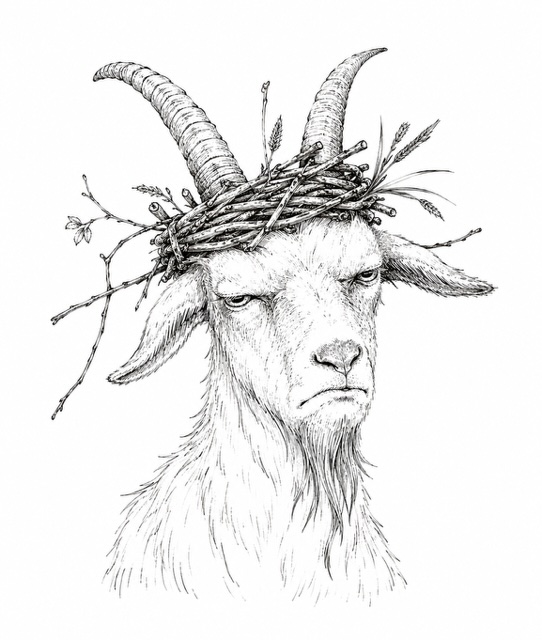
She placed the winner’s crown onto Bres’s head and turned him into a goat.
The village laughed and cheered, mostly laughed. After all, a furious goat bleating and running in circles would amuse anyone.
‘Now, Conor,’ said the sorceress, ‘what prize do you name? Eithne’s hand?’
‘No,’ said Conor. ‘Eithne’s hand is hers to give. I claim a fair price for flour from this mill, for every household and every harvest. These games were begun so that no house would go hungry. It is time we remembered that.’
The goat was fed and watered and cared for, and every August after, when the games came round again, somebody would catch a wild one down off the mountain, sit him up on a stand above the crowd, and crown him all over again, in memory, though most people telling it now have long since forgotten what exactly it’s in memory of.
Eithne married nobody that year, which suited her fine, and married Conor two harvests later, which suited her better. With flour fairly priced once more, Eithne’s father never had to raise the price of a loaf again.