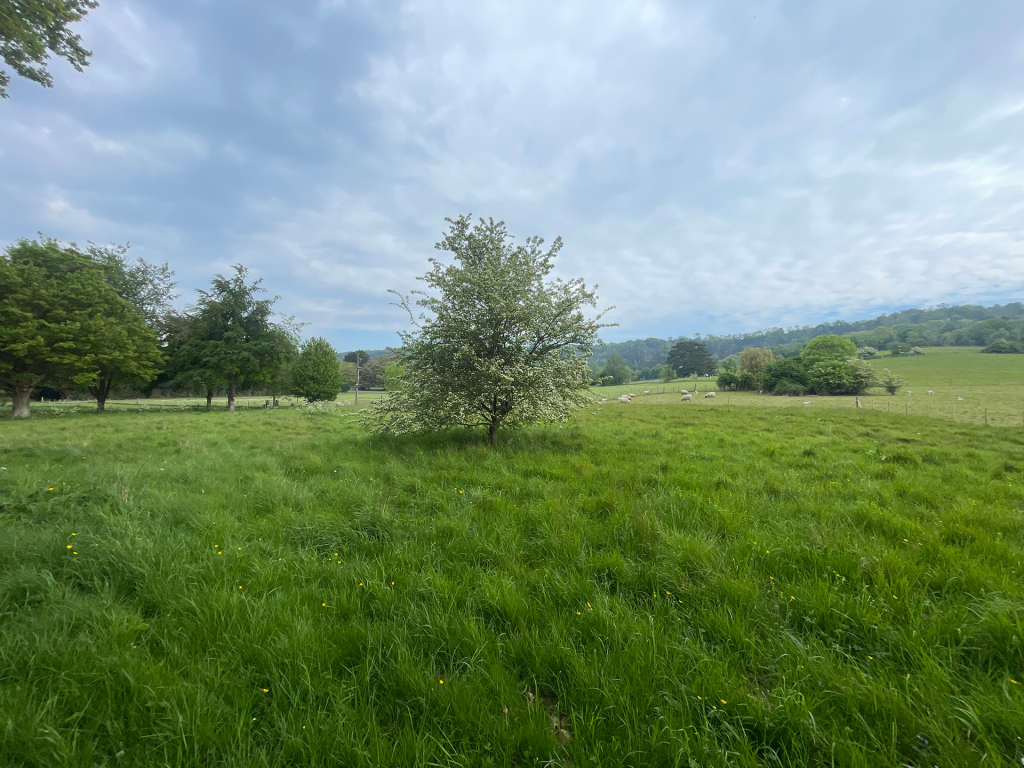
The Hawthorn
The hawthorn is also known as the May tree, we plant it now for hedging, that’s actually been its role for thousands of years, long before humans got involved.
The hawthorn is a liminal tree, that word comes from the Latin limen, threshold or doorstep, it describes the state of being in-between. In folklore across the world, the threshold is full of meaning. In stories it’s where the hero goes from the known to the unknown, both physically and metaphorically, where the rules of the ordinary world stop applying.
The faerie world, in British tradition, doesn’t live in the deep forest. It lives at the edge. The hedge.
The faeries are intimately associated with the hawthorn, it was believed that the tree was a meeting place or a portal for the faeries to cross over to the mortal world. Woe betide anyone who fell asleep under a hawthorn tree, they were likely to be whipped away to the faerie world as they slept.
Solitary hawthorn trees are known as fairy thorns, and there is still a living belief in parts of Ireland and rural Britain, farmers plough around them, roads are built around them.
In 1999, a major road scheme in County Clare was diverted to avoid disturbing a fairy thorn. It is also believed that, because the hawthorn is a portal for faeries, cutting one is to invite catastrophe, not just some bad luck, but real catastrophe.
This is one of the few places where pre-Christian belief has genuinely survived.
That pattern, the threshold between what we know and what we don’t, is one of the oldest recurring structures in human storytelling. It appears in myth, in fairy tale, in ritual, and religion. It’s not British or Celtic, it belongs to all of humanity. We have always needed a way to name the moment certainty runs out and something else begins. The hawthorn hedge, standing at the edge of the field, does that. You can see it, touch it, stand at it and look through.
It’s so powerful for children because they live at the threshold.
Imagine the world like a map, as adults and inhabitants of the 21st century, we can see the whole map, every mountain and stream and valley filled in. Children now, and our ancestors back then did not have that, everywhere they look is uncharted territory, they can cross the boundary to new knowledge, facts and learning, but also about who they are and who they’re becoming, moving between the safe and the unknown.
That is childhood (and it still can be in adulthood if we want it to).
A hawthorn hedge gives them a physical object that represents what they feel but may not be able to describe.
A few weeks ago, we found out something about hawthorn blossom that we didn’t know. We brought some hawthorn inside, because it smells so beautiful outside, except that it doesn’t. Inside it smells a bit like a decomposing animal that’s died in a bush somewhere, you can’t see it, but you know it’s there.
It turns out that the flowers contain a chemical called trimethylamine, the same compound produced by decomposing animal tissue. Outside, in the open air, it’s masked by spring.
People felt this for centuries, there has always been a taboo about bringing hawthorn inside, they thought it would bring illness and death. For centuries our ancestors the world over knew that this belonged outside, they built a cultural rule around it, long before we discovered the science behind it. They felt something to be true, without being able to name it.
There is an old belief in Britain that where oak, ash and thorn grow together, you are standing in a fairy place. The three trees form a kind of trinity, each with its own place in folklore, but together they become something more magical than any of them alone. Rudyard Kipling put it into ‘Puck of Pook’s Hill’ in 1906, he didn’t invent it, it was already there, he just wrote it down.
The thorn in that triad is hawthorn. It’s the third point, the one that completes the threshold. Oak for strength and endurance, ash for connection between worlds, and hawthorn for the boundary itself. The crossing point. When all three are present, the folklore says, you are somewhere the ordinary rules don’t quite apply.
You don’t need to believe in faeries for this to mean something. What it describes is a place where the world feels different, where the usual sense of things gives way to something older and less certain.
The Glastonbury Thorn is a hawthorn, said to have grown from the staff of Joseph of Arimathea when he drove it into the ground on Wearyall Hill after arriving in Britain. The story has been there since at least the 12th century. What makes it extraordinary isn’t the legend, it’s the detail: the tree flowers twice a year. Once in May and once at Christmas, no other hawthorn does this.
Every year, a sprig of the Glastonbury Thorn is cut and sent to the monarch for Christmas. This has happened for centuries. It still happens now.
Think about what that gesture actually is, the head of state of a modern nation receiving a cutting from a tree that, by tradition, flowers out of season, grown from a staff planted by a biblical figure on an English hillside two thousand years ago.
Whatever the official framing, what’s underneath it is the same impulse that kept the fairy thorns standing in Irish fields while roads bent around them.
The hawthorn doesn’t just mark the threshold symbolically, it enforces it physically. Stick your hand in one and tell me different. They are the plant’s instruction: be careful where you touch. Be careful how you cross.
A child standing at a hawthorn hedge doesn’t need to be told any of this. The lesson about boundaries, about the fact that some crossings require care and attention and respect, is written into the structure of the thing itself. The symbolism and the physical reality are the same lesson delivered twice, in two different languages, at the same moment.
This is what we mean when we say folklore is a teaching technology rather than a collection of old stories. The hawthorn hedge was doing this job long before anyone designed a curriculum around it. This is what’s so brilliant about nature, it’s been teaching for millennia, the lessons are already there, you can just get out of the way and let it do its job.