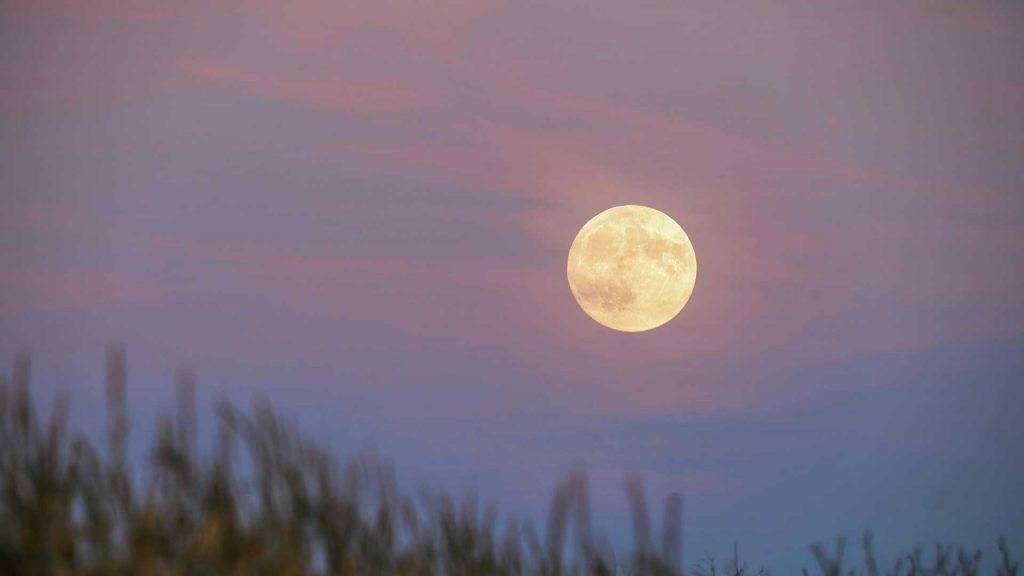
Harvest Moon
The Harvest Moon – Light of Gratitude
Tomorrow night, the full moon rises bright and golden, the Harvest Moon, one of the most recognisable and meaningful moons of the year. Its glow is longer and brighter in the evening sky, giving farmers precious extra light to gather their final crops before the long nights of winter. The forecast for tomorrow night says overcast early, but hopefully a few breaks in the cloud later on in the evening.
Normally we see the Harvest Moon in late September, but this year is unusually late. The Harvest Moon is the full moon closest to the autumn equinox and this year just happens to be in October so really is a last golden light before the nights draw in.
Names and Meanings
Across the world, this moon is known by many names. In Britain and much of Europe, it’s the Harvest Moon, Lune des moissons in French or Erntemond in German, the full moon nearest to the autumn equinox. In North America, it’s sometimes known as the Corn Moon, Barley Moon, or Fruit Moon, names that appeared in early farmers’ almanacs, reflecting the crops being gathered at this time. In China, it coincides with the Mid-Autumn Festival, a time for lanterns, mooncakes and reunion. In the Southern Hemisphere, they have their Harvest Moon in March or April.
Whatever the name, this moon marks a time of gratitude, for food, light, warmth, and a celebration of the gathering of the harvest. The golden colour of the rising moon reflects the fields below: ripe corn, barley, wheat and oats, the orchards laden with apples and the last of the pears.
As a slight aside, by the time the Harvest Moon appears, the last of the blackberries are turning, folklore tells that after Michaelmas (29 September), the Devil spat upon them in anger after falling into a thorn bush when he was cast from Heaven. The story goes that from that day the berries turn sour and unfit to eat, another reminder that the season of plenty is closing, and that it’s time to be thankful for what the land has given.
Traditions and Folklore
Before artificial light, the extra brightness of the Harvest Moon was a gift. Farmers and villagers worked by its glow, finishing their harvest late into the night. Songs and feasts followed, tables laid with bread, apples, and beer brewed from the summer’s grain. In many rural communities, Harvest Home celebrations gave thanks to the land, the weather, and one another.
Across Europe, harvest festivals still echo these old customs. In Germany, the celebration is called Erntedankfest, literally “the feast of thanks for the harvest”. Traditionally marked in early October (and celebrated this year on 5 October), it brings church services, music, processions, and community meals piled high with bread, grain, and fruit. Wreaths woven from ears of corn are carried in parades or hung in barns to honour the bounty of the year. The spirit is the same as in Britain’s Harvest Festival, gratitude for the land and those who work it.
In France, many rural communities hold La Fête des Moissons, the Festival of the Harvest. It’s an old tradition revived in villages and vineyards each autumn, especially in wine-growing regions. Grapes are gathered, bread is baked, and people come together for music, dancing, and shared meals. In some towns, decorated carts and bundles of wheat are carried through the streets to bless the year’s yield.
In Japan, the season is marked by Tsukimi (literally “moon-viewing”), a festival honouring the full moon and the abundance of the rice harvest. Families gather to offer rice dumplings, chestnuts, and pampas grass to the moon, reflecting gratitude and the beauty of impermanence. It’s quieter than many European harvest feasts but carries the same sense of reverence for nature’s cycles and the gifts of the land.
It was a time for reflection all across the globe. As the year turned toward darkness, people thought about what they had gathered, what they had worked for, and gave thanks for the harvest before turning their attention to the long winter months ahead.
In the Setting: Learning and Thankfulness
The Harvest Moon offers a wonderful chance to reconnect with the land, the seasons, and the idea of thankfulness for what nature provides. Here are some ways to explore it with different age groups:
EYFS
- Moon Watch – Go outside before dark, notice how the moon looks and feels. Use torches to explore light and shadow.
- Thankful Circle – Sit together and talk about something each child is thankful for – a friend, a pet, a tree, the rain.
- Harvest Art – Use natural colours (mud, leaves, berries) to paint or print moon shapes.
KS1
- Storytime – Share simple harvest tales: The Little Red Hen, or stories about the moon lighting the fields.
- Moon Phases Craft – Create a moon wheel showing how it changes through the month.
- Harvest Table – Collect objects from nature to make a small display: grains, leaves, apples, conkers, talk about how they connect to autumn.
KS2
- Folklore and Science – Learn why the Harvest Moon seems larger and rises earlier. Discuss how people once explained it through story and now through science.
- Gratitude Writing – Write short poems or reflections: “I am thankful for…” tied to the natural world.
- Mapping the Harvest – Talk about where our food comes from and what crops are being gathered in the UK right now.
KS3 and Above
- Cultural Comparisons – Explore the Harvest Moon in other cultures: the Mid-Autumn Festival (China), Chuseok (Korea), or Harvest Home in England.
- Sustainability Discussion – What does ‘harvest’ mean today in a world of supermarkets and global supply chains? How do we stay connected to the land?
- Evening Gathering – If possible, hold a small outdoor gathering to watch the moon rise. Encourage students to bring a small symbolic offering of thanks, a poem, a song, or something found in nature.